This Week's Tip: Book Reviews and The Quality Teaching Model
Today I found a great site for teaching English in middle to upper primary and secondary classes. Writing with Writers takes you step by step through the process of writing a book review. Rodman Philbrick shares a book review that he has written that can be used as a model for students' own writing. He then gives a series of writing tips to guide students and reminds them of a few challenges to keep in mind. Philbrick provides some guidelines for revising work upon completion and suggests a site where students can publish the final draft of their book review.
I found this site really useful as everything was explained so clearly and could be displayed on my Interactive Whiteboard for students to return to as they wrote. While my students haven't completed and published it yet, I can see the value of having a real purpose and audience for their writing.
This resource has great potential for implementing two dimensions of the Quality Teaching Model. (For summarised explanation of the elements of QTM click here.) These are the connections that I can readily see, but you may see other connections as well:
Intellectual Quality
Deep Knowledge - This tool can be used to give detailed explanation of how to write a book review.
Deep Understanding - Students demonstrate a deep understanding of the book they read
Problematic Knowledge - Students recognise that people have different opinions about books and come to value the opinions of others
Higher-Order Thinking - Students are involved in analysis and synthesis and evaluation as they reflect on their book and the author's style.
Metalanguage - Philbrick uses language that students can understand and explains terms like 'genre'.
Substantive Communication - Teachers could use Philbrick's example to create discussion about what makes it effective. Discussion could take place in small groups which then share key thoughts with the whole group.
Quality Learning Environment
Explicit Quality Criteria - Philbrick's model and tips provide explicit quality criteria that students can revisit as they write.
High Expectations - The section on reviewing work challenges students to revisit their ideas and improve their initial drafts.
Students' Self-Regulation - The writing task is purposeful and students can continually monitor their own work using the tips.
Ideally, I'd teach this lesson using an Interactive Whiteboard and a classroom full of student computers or laptops. The explanation and discussion could take place with the Whiteboard, and then students could type their reviews in a word processor, referring to the website as they typed. Once completed, the text could be revised and then copy/pasted into the review page. What a great integration of ICT!
Showing posts with label Quality Teaching Model. Show all posts
Showing posts with label Quality Teaching Model. Show all posts
Tuesday, September 8, 2009


Tuesday, August 25, 2009
Tech Tips Tuesday
This Week's Tip - IWB Pages
I've been playing with my Interactive Whiteboard more than usual this week. I designed some pages to give other teachers ideas for how they can use their boards. I'm trying to get teachers to turn their boards on at the start of the day so that they are more likely to continue to use them throughout the day. If you have a Smart Board, you can create similar pages of your own.
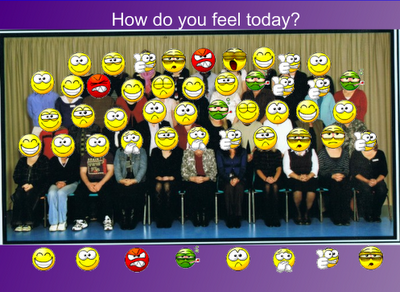
This first page is a fun way of marking the roll. I used this one for the teachers' staff meeting, but I use the same idea with my class photo. It is simple to make and the kids love it. When they arrive each day, they choose the face that best fits how they feel, and drag it over their face. I can see at a glance how students are feeling and who is yet to arrive. This is great for creating a class community and learning environment. To start fresh the next day, select the faces with a click and sweep action and delete.
To Make This Page:
Step 1: Scan or upload a class photo
Step 2: Insert photo
Step 3: Use text to add a heading
Step 4: Save emoticons from My Emoticons
Step 5: Insert emoticons and place beneath photo. Right-click on them and choose the "Infinite Clone" option.
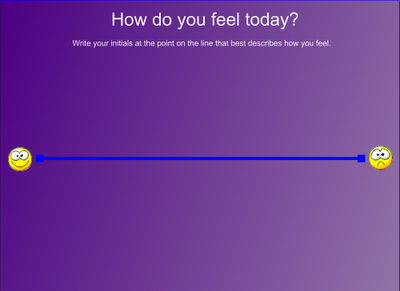
For another option, you could make a simple line and students determine their mood on a scale between happy and sad. They write their initials to place themselves.
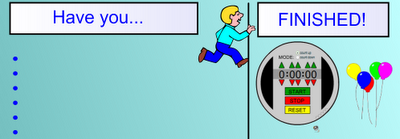
This page is for students to self-regulate as they are finishing their work. You write in the explicit quality criteria for the dot points and set the timer for the desired time. When students have finished the work they move their photo (not shown) or name across the line and hit the little sound icon (near the balloons) to hear a cheer.
 To make this page:
Step 1: Make headings (I used a rectangle shape and then a text box)
Step 2: Divide page with a line
Step 3: Add bullet points (you need to put a space before pressing return/enter in order to keep the dot point)
Step 4: Insert timer and balloons and runner from the gallery (search for 'timer' and 'cheer' and 'race')
Step 5: Insert small photographs of students (100 x 75 pixels) or write/type names in individual text boxes.
I've been playing with my Interactive Whiteboard more than usual this week. I designed some pages to give other teachers ideas for how they can use their boards. I'm trying to get teachers to turn their boards on at the start of the day so that they are more likely to continue to use them throughout the day. If you have a Smart Board, you can create similar pages of your own.
This first page is a fun way of marking the roll. I used this one for the teachers' staff meeting, but I use the same idea with my class photo. It is simple to make and the kids love it. When they arrive each day, they choose the face that best fits how they feel, and drag it over their face. I can see at a glance how students are feeling and who is yet to arrive. This is great for creating a class community and learning environment. To start fresh the next day, select the faces with a click and sweep action and delete.

To Make This Page:
Step 1: Scan or upload a class photo
Step 2: Insert photo
Step 3: Use text to add a heading
Step 4: Save emoticons from My Emoticons
Step 5: Insert emoticons and place beneath photo. Right-click on them and choose the "Infinite Clone" option.
For another option, you could make a simple line and students determine their mood on a scale between happy and sad. They write their initials to place themselves.

This page is for students to self-regulate as they are finishing their work. You write in the explicit quality criteria for the dot points and set the timer for the desired time. When students have finished the work they move their photo (not shown) or name across the line and hit the little sound icon (near the balloons) to hear a cheer.
 To make this page:
Step 1: Make headings (I used a rectangle shape and then a text box)
Step 2: Divide page with a line
Step 3: Add bullet points (you need to put a space before pressing return/enter in order to keep the dot point)
Step 4: Insert timer and balloons and runner from the gallery (search for 'timer' and 'cheer' and 'race')
Step 5: Insert small photographs of students (100 x 75 pixels) or write/type names in individual text boxes.
Friday, August 7, 2009
Friday Fun - 7/8/09
I really enjoyed this week as it was a nice balance of classroom and administration. The classroom felt settled and successful and the students were engaged in the lessons. In my administrative role I achieved a lot - planning, paperwork, phone calls, supporting teachers, and observing lessons. I've given a couple of lengthy explanations today in case you would like to replicate the things we've done in your own lessons.
Fun This Week
Skilling with Textiles
We launched into some skill development with textiles this week. I conducted an online survey with students (using Tiger Survey) to determine students' prior skills with knitting, sewing, crochet etc and to find out what equipment they had access to. I asked students to volunteer to be coaches if they classified themselves as experts with particular textile skills. Students then selected which groups they would like to join to develop their basic skills. As we didn't have quite enough equipment for the first session, some students created God's Eyes and then brought in some extra equipment for additional sessions.
The knitting coaches were a little nervous about starting their group as they weren't sure how to cast on. At recess, in the staff room, I found out that our librarian knew how to cast on and had some time that she was willing to share to teach it to the coaches. While she explained it to them I recorded the explanation using my mini camcorder so that they could revisit it later if they needed to. They practiced during their lunchtime and were ready to start after lunch. I was amazed by how well they remembered the instructions and were able to teach the others.
Students were allocated an area and then the coaches ran their sessions with minimal support. They were responsible for ensuring their materials were cleaned up and their areas tidy at the end of the session.
As students complete one skill area, they are welcome to move to another group to try out a new skill. At this stage the emphasis is more on trying new skills than on creating a finished product.
That said, the students with the weaving looms have successfully made beanies and scarves; the sewing group have made little cushions; the crocheters have made snakes and lizards (from a basic chain); and the knitters are well underway with knitting rows. Mid-week another group started up with french knitting using cardboard rolls and paddle pop sticks.
I've been impressed to see that the kids are loving it all so much that they are even doing it during their lunch breaks and asking to take it home. Two students have already created textiles projects at home and turned them in. It's great to see their enthusiasm.
Touch Footy
We are preparing students for a Touch Football Gala later in the term, so after our Maths sessions we go down to the oval to do some skill-building. Some of the boys are particularly keen about this and they are grabbing a ball to continue practice during lunch. We are hoping to get some mini games started next week.
Munching in Maths
For one of the Maths lessons I bought a bag of apples and used them to help students apply maths to everyday life. I must say that I was particularly lucky as the numbers kept working in my favour.
We weighed one apple (125g) and then students tried to calculate how many apples there should be in a 1kg bag. Some worked it out by adding 125 repeatedly and keeping a running total. Some worked it out by doubling and tracking the number of apples. And others worked it out by dividing 1000 by 125. As it turned out, for whatever reason, there were actually 9 apples in the bag instead of the 8 we calculated mathematically! We also discovered that it was possible that the scales weren't so accurate.
We then created a new word problem that required students to determine how much one apple would cost if the whole bag was $4. I passed out some calculators for students to use to assist them. Students were a little boggled by the decimal result they got 0.44444 and thought it must be wrong. One of the students worked out what it meant and explained it to the class. So then I asked students to work out how much 2 apples would cost; 3 apples; 6 apples; 5 apples and we discussed how to work out the answers mentally. Then I flipped it around the other way - how much would half an apple cost? A quarter? As you can see, the numbers were very favourable as they were easy to multiply and divide.
One of the students called out "Can we EAT the apples?" So we launched into yet another problem to be solved - How much apple can each student have? With 9 apples and 25 students, there weren't enough for one each, so we would have to divide them into halves. Students calculated that we would have 18 halves - still not enough pieces. But then we realised that if we cut them into quarters, we would have spare pieces. I demonstrated this on the board as an example of division with remainders (which we learnt earlier in the week). 36 pieces would give us 1 quarter each, then 11 remaining pieces. One student decided that they didn't want any apple, so then we were looking at 24 students and 12 remaining pieces. While they munched on their apple I asked students to think about what they know about the relationship between 24 and 12. One student pointed out that 12 is half of 24. So how does this help us with dividing up the remaining pieces? Another student realised that we could cut the remaining quarters into half again to make another 24 pieces. So what would these pieces be called? One student worked it out and another explained how they came to the answer. They then worked out how many eighths they had had altogether.
You could feel the energy in the classroom as students buzzed from one calculation to another and solved the real-life problems.
Dancing
We explored anger through our dancing this week. We told students the story of a farmer who was angry because some of his workers broke the machinery. There were three parts to the dance music - the angry farmer who stomps and shakes his fist, the trembling workers and the broken machinery. Students explored these roles through dance and then worked in small self-selected groups to create and present their own dances. I was captivated by the way they told the story through dance.
Leadership Assembly
We had a school assembly to recognise and welcome in the new SRC and Enviro Squad for the second half of the year. Students also received certificates for their achievements in the Computer and Science competitions.
Fun This Week
Skilling with Textiles

We launched into some skill development with textiles this week. I conducted an online survey with students (using Tiger Survey) to determine students' prior skills with knitting, sewing, crochet etc and to find out what equipment they had access to. I asked students to volunteer to be coaches if they classified themselves as experts with particular textile skills. Students then selected which groups they would like to join to develop their basic skills. As we didn't have quite enough equipment for the first session, some students created God's Eyes and then brought in some extra equipment for additional sessions.
The knitting coaches were a little nervous about starting their group as they weren't sure how to cast on. At recess, in the staff room, I found out that our librarian knew how to cast on and had some time that she was willing to share to teach it to the coaches. While she explained it to them I recorded the explanation using my mini camcorder so that they could revisit it later if they needed to. They practiced during their lunchtime and were ready to start after lunch. I was amazed by how well they remembered the instructions and were able to teach the others.
Students were allocated an area and then the coaches ran their sessions with minimal support. They were responsible for ensuring their materials were cleaned up and their areas tidy at the end of the session.

As students complete one skill area, they are welcome to move to another group to try out a new skill. At this stage the emphasis is more on trying new skills than on creating a finished product.
That said, the students with the weaving looms have successfully made beanies and scarves; the sewing group have made little cushions; the crocheters have made snakes and lizards (from a basic chain); and the knitters are well underway with knitting rows. Mid-week another group started up with french knitting using cardboard rolls and paddle pop sticks.
I've been impressed to see that the kids are loving it all so much that they are even doing it during their lunch breaks and asking to take it home. Two students have already created textiles projects at home and turned them in. It's great to see their enthusiasm.
Touch Footy
We are preparing students for a Touch Football Gala later in the term, so after our Maths sessions we go down to the oval to do some skill-building. Some of the boys are particularly keen about this and they are grabbing a ball to continue practice during lunch. We are hoping to get some mini games started next week.
Munching in Maths
For one of the Maths lessons I bought a bag of apples and used them to help students apply maths to everyday life. I must say that I was particularly lucky as the numbers kept working in my favour.
We weighed one apple (125g) and then students tried to calculate how many apples there should be in a 1kg bag. Some worked it out by adding 125 repeatedly and keeping a running total. Some worked it out by doubling and tracking the number of apples. And others worked it out by dividing 1000 by 125. As it turned out, for whatever reason, there were actually 9 apples in the bag instead of the 8 we calculated mathematically! We also discovered that it was possible that the scales weren't so accurate.
We then created a new word problem that required students to determine how much one apple would cost if the whole bag was $4. I passed out some calculators for students to use to assist them. Students were a little boggled by the decimal result they got 0.44444 and thought it must be wrong. One of the students worked out what it meant and explained it to the class. So then I asked students to work out how much 2 apples would cost; 3 apples; 6 apples; 5 apples and we discussed how to work out the answers mentally. Then I flipped it around the other way - how much would half an apple cost? A quarter? As you can see, the numbers were very favourable as they were easy to multiply and divide.
One of the students called out "Can we EAT the apples?" So we launched into yet another problem to be solved - How much apple can each student have? With 9 apples and 25 students, there weren't enough for one each, so we would have to divide them into halves. Students calculated that we would have 18 halves - still not enough pieces. But then we realised that if we cut them into quarters, we would have spare pieces. I demonstrated this on the board as an example of division with remainders (which we learnt earlier in the week). 36 pieces would give us 1 quarter each, then 11 remaining pieces. One student decided that they didn't want any apple, so then we were looking at 24 students and 12 remaining pieces. While they munched on their apple I asked students to think about what they know about the relationship between 24 and 12. One student pointed out that 12 is half of 24. So how does this help us with dividing up the remaining pieces? Another student realised that we could cut the remaining quarters into half again to make another 24 pieces. So what would these pieces be called? One student worked it out and another explained how they came to the answer. They then worked out how many eighths they had had altogether.
You could feel the energy in the classroom as students buzzed from one calculation to another and solved the real-life problems.
Dancing
We explored anger through our dancing this week. We told students the story of a farmer who was angry because some of his workers broke the machinery. There were three parts to the dance music - the angry farmer who stomps and shakes his fist, the trembling workers and the broken machinery. Students explored these roles through dance and then worked in small self-selected groups to create and present their own dances. I was captivated by the way they told the story through dance.
Leadership Assembly
We had a school assembly to recognise and welcome in the new SRC and Enviro Squad for the second half of the year. Students also received certificates for their achievements in the Computer and Science competitions.
Friday, June 5, 2009
New Gold Mountain #2
 This week my literacy class continued reading New Gold Mountain: The Diary of Shu Cheong by Christopher W. Cheng. This is an historical fiction which is part of the "My Australian Story" series. It tells the story of life on the goldfields at Lambing Flat, NSW in 1860-1861. Shu Cheong, a fictitious character travels to Australia to find gold to take back to his village. On the journey both his father and third uncle die, leaving Shu Cheong alone in a foreign country. The local Chinese Society arrange a foster parent (Uncle) for Shu Cheong.
Details of pages 1-30
Summary of Pages 30-70
In these pages we learn more about life on the goldfields and see an increase in the tension between the European and Chinese miners. After a confrontation with one of the Chinese miners who was mining in an abandoned European mine, the European miners drive the Chinese out and they are stranded in the bush, surviving on what plants and bugs they can find. On their return to the goldfields they need to purchase new tools and get themselves set up again. Life continues as normal until again they are forced from their tents.
Activities
Reading: The reading part of this unit is done in a variety of ways: teacher reading to the class, students reading to the class, students reading in pairs or independently. While students are reading, I sit alongside them and ask questions and/or make anecdotal notes about fluency/expression/self-correction etc.
Code Breaker: Continue to build the vocabulary chart and discuss new words as they are encountered in the text.
Text User: Consider first-person perspective in historical fiction. Students work in teams to collect information about convicts and their lives from books (20mins). Students sit in a big circle. Each contributes one fact they learnt from their research so that everyone can benefit from their knowledge. Students then begin writing a diary entry from the perspective of a convict.
Text Participant: Students write their names using Chinese script (see lesson here).
Text Analyst: Students discuss the bullying of the Chinese and consider how it would feel to be in their position. Students share own experiences of being burgled. Explain the difference that having insurance makes - in those days they lost everything and had to start from scratch (15 mins). Students then read factual recounts of the treatment of the Chinese on the goldfields. They highlight relevant passages and share this with the class in a discussion (25 mins). Students then work independently to write speeches from the perspective of a Chinese miner or European miner trying to convince the other European miners to stop harrassing the Chinese. Use Jenny Eather's Writing Fun page on Persuasive writing as a guide. On completion, students who wish to can present their speech to the class. (We recorded these with the Flip Mino to share on our My Classes page).
From a Quality Teaching Model perspective, this lesson was great for developing deep knowledge and deep understanding, using higher order thinking, allowing for substantive communication, and improving problematic knowledge through seeing things from the various perspectives.
Tuesday, June 2, 2009
Tech Tips Tuesday
This Week's Tip: Attempting to Implement the Quality Teaching Model with the Aid of ICT #1
One of my goals for this year is to find a way to use ICT as a tool with the Quality Teaching Model (currently being implemented in NSW and the ACT) to improve teaching and learning in the classroom. I do a lot of this automatically, but I want to be able to share these ideas with others. Of course, the success of the lesson is not solely dependent on the actual ICT, so it makes it a little hard to suggest that any one tool or strategy is good for any one of the elements of the Quality Teaching Model. I want to share this journey with you and help you to see that the ICT needs to be embedded in quality teaching and pedagogy and not just used as an add-on.
For example, today ICT wasn't the focus of my lesson, but was definitely a helpful tool in my preparation. My students and I have been reading "New Gold Mountain" by Christopher W Cheng, which is about a Chinese boy, Shu Cheong, who came to Australia to find gold during the goldrush. I want my students to connect with the story personally and to gain a greater respect for Chinese culture as a result. As Shu Cheong is learning to write English words in the book, I thought it might be helpful for students to try writing their names with Chinese characters. In preparation for today's lesson, I downloaded the following videos from You Tube and translated all my students' names into Chinese characters at Chinese Names.org. After reading and discussing a few pages together as a class, we watched the videos to see Chinese calligraphy being created by the experts.
While students were watching, I set out some black ink, brushes and paper on each of the desks. Students then attempted to write their names using the little name strips I'd prepared for them earlier. Also whilst reading, we did a Google search for Cai Shen in our attempt to find out more about one of the gods mentioned in the book. Throughout the book reference is given to Chinese religious beliefs so we wanted to know more in order to understand his perspective more fully.
Quality Teaching Model Coding
For this lesson I will only look at the Intellectual Quality dimension.
The videos helped to provide deep knowledge about the art of calligraphy and the style used by calligraphers. It didn't really provide detailed knowledge about the history of calligraphy, but it did allow students to see calligraphy in action.
Students haven't yet demonstrated a deep understanding of their experience with trying to write in another script. Further discussion would allow me to see whether this activity has helped them to identify with the experiences of the Shu Cheong in the book.
Our discussion during reading touched on metalanguage when we defined some words in the text. To improve this element further, I could have discussed the Chinese script and sought comparisons with the script we use for English (does anyone know what our script is called?).
The videos inspired substantive communication around calligraphy and it's use in both China and Japan. Students shared of their own experiences with calligraphy and together we discussed whether Chinese script should be written horizontally or vertically.
I don't feel that this lesson really allowed for higher order thinking. The lesson was generally teacher-directed and students didn't really ask or answer any questions that required higher order thinking.
The discussion around religious beliefs added a little to the provision for problematic knowledge - where ideas can be shared from a variety of viewpoints - but again, I feel that we explored the ideas of Chinese spirituality, but only touched on other religious viewpoints.
As I hope you can see, it's not the resources that you use that make it quality teaching or not, it's what you do with them and the thinking that results through discussion and careful questioning. I see that I have some work to do to further improve my teaching in these areas!
Thursday, February 19, 2009
Friday Fun - 20/2/09
Fun this week:
Bushwahzee
On Wednesday we had a travelling performance group, "Bushwahzee", visit the school. They worked throughout the school day to coordinate a range of dance moves with our classes. Then, in the evening, families came back to the school to see the performance. This year's theme was "Beach Party" so the kids came dressed up in board shorts and Hawaiian shirts. Some even wore grass skirts! It made for a really enjoyable evening and everyone seemed to be having a lot of fun. Things like this are great for bringing the community together, raising morale and building a sense of unity.
SuperClubsPlus
I had a mix of good and bad news this week. The good news was that everything is just about ready for us to run with SuperClubsPlus. The bad news is that my state's Department of Education doesn't support student blogging, so it seems unlikely that we will be able to have a class blog in the near future. We will still be able to communicate with families through My Classes, The School Website, and my blog; and we'll be able to explore a safe Web2.0 through kid-friendly SuperClubsPlus. This week I introduced students to SCP and sent home the registration forms. Once I get these back we can get registered and get moving.
Voice Thread Challenge
I tried to implement my newspaper idea using Voice Thread this week, but I kept coming up against obstacles. When I signed up for Voice Thread, it seemed that I could use it free as a teacher, but since then I have been receiving messages to say I need to pay money. I could cancel out of those pop-ups, but then I kept having issues with the running of Voice Thread. It kept jumping to the save/embed page and for some reason our voices weren't recorded. On top of all that, I've been told that my state's Department of Education doesn't like us using anything that publishes student work on third-party websites. So...after all of that, I have decided to use the Smart Board software or maybe PowerPoint to achieve these outcomes instead! If I use PowerPoint, I should still be able to share the final product with families through school websites.
Friends Book
As part of our unit of work on the FRIENDS values, we put together a book about all the people in our grade. Students chose a name out of a hat and thought of three or more positive things about that person. After they decorated the page, we bound them all together and read the book. It's a great resource to get to know the kids better and made for a great team-bonding activity.
Maths
This week my maths group was focusing on 10 times tables and place value. I finally got around to setting up a Smart Board Notebook with all the pages I like to use in a Year 4 Maths lesson. I have a timer, hundred chart, place value chart, calculator, piggy bank and coins, number line, website links and other activities to promote Mathematical thinking. I also tried out my webcam/document scanner for a dice activity. Below is a video demonstration of this activity. (My first demo video - feedback is more than welcome!)
One place value game the class particularly enjoyed is called Wipeout. Students typed 21 469 into their calculators. Then they had to 'wipe out' the numbers using subtraction. For example, to wipe out the 4, they have to subtract 400. As students become more familiar with this activity they can play it together in pairs, or even individually.
Williamstown High School Band
On Friday afternoon we had a visit from the Williamstown High School Band (from Victoria) who played a number of great songs and introduced their instruments to us. Our children were enthralled and bobbed along to the music. I always love to watch the way students respond to music - it really adds to the atmosphere and has a positive effect on mood.
Rowan of Rin
We began reading Rowan of Rin by Emily Rodda and completed a number of activities related to the book. I will publish these in a separate post over the weekend.
Friday, February 13, 2009
Friday Fun - 14/2/09
Olympic Visitor
We had Beijing 1500m runner, Lisa Corrigan visit our school on Monday to talk to the students about her experiences as a runner and to promote the Kids' Marathon in April. She taught us some pre-run exercises and stretches. Fran, who is involved with our local marathon showed us an Olympic Torch from the Sydney Olympics when she was selected to be part of the torch relay. Then we all went out on the school oval to run a lap behind Lisa. A number of kids have taken applications for the Kids' Marathon, demonstrating an interest in participating in this event.
Come Back Gizmo
We have been reading Paul Jennings' Come Back Gizmo. We finished it on Monday afternoon and then did a related creative writing task on Tuesday. Together we created a mind map in Kidspiration to consider ideas for writing.

Cricket
Jonathan and I split the group into a girls group and a boys group for cricket games. The girls played French Cricket with me and the boys played 3-wicket cricket with Jonathan.
Spelling
We started our spelling groups this week. We used a Spelling Inventory to determine word families/patterns that students need to learn. Jonno worked out list words for each of these groups and activities for students to work on to practice their spelling further. I set up the list words in Spelling City for my early finishers to work with. This was recommended to us on Mr Hancock's Class Blog.
Maths
I am trying out Smart Kiddies for interactive whiteboard activities to supplement my lessons. So far it seems to be working well. Teachers can register for free and use the resources in the classroom. This week we used activities from the Place Value and Number Patterns sections. We also used Molecule Maths from Fiery Ideas to practise ordering numbers from lowest to highest. Early finishers then used these chains to practise adding.
Newspapers
In Australia we are going through the aftermath of some terrible fires. This week we looked at newspaper articles about the fires. We looked at keywords in these articles and sought out the who, what, when and where of the stories before writing a summary sentence. We looked at what came up when the text was inserted into Wordle.
We read a Daily Telegraph feature about newspapers, then watched a video about the process behind making a newspaper. Students then found an article in the paper and labelled the headline, picture, caption, first paragraph (including who, what, when and where), quotes, writer and photographer (if given). Early finishers then wrote a summary sentence about the article they chose.
Singing
The jump from Year 1 to Year 4 has been tricky for me in terms of attention gaining tools and transition activities. In the past I clapped rhythms to get students to stop work and look my way. I'm not sure if it's too babyish for Year 4s! I also sang with students during transition time to avoid chaos, but all my songs were for younger children.
This week I borrowed a Sing CD from the library and started teaching the kids some new songs. We are really enjoying the Shoo Fly/ Get that fly! Medley. I can't seem to get it out of my head!
Reflective Journals
On Fridays students write an entry in their reflective journals. They consider their challenges and successes during the week and write their plans for the next week. We are really encouraging our students to be more reflective and to take charge of their own learning and growth.
We had Beijing 1500m runner, Lisa Corrigan visit our school on Monday to talk to the students about her experiences as a runner and to promote the Kids' Marathon in April. She taught us some pre-run exercises and stretches. Fran, who is involved with our local marathon showed us an Olympic Torch from the Sydney Olympics when she was selected to be part of the torch relay. Then we all went out on the school oval to run a lap behind Lisa. A number of kids have taken applications for the Kids' Marathon, demonstrating an interest in participating in this event.
Come Back Gizmo
We have been reading Paul Jennings' Come Back Gizmo. We finished it on Monday afternoon and then did a related creative writing task on Tuesday. Together we created a mind map in Kidspiration to consider ideas for writing.

Cricket
Jonathan and I split the group into a girls group and a boys group for cricket games. The girls played French Cricket with me and the boys played 3-wicket cricket with Jonathan.
Spelling
We started our spelling groups this week. We used a Spelling Inventory to determine word families/patterns that students need to learn. Jonno worked out list words for each of these groups and activities for students to work on to practice their spelling further. I set up the list words in Spelling City for my early finishers to work with. This was recommended to us on Mr Hancock's Class Blog.
Maths
I am trying out Smart Kiddies for interactive whiteboard activities to supplement my lessons. So far it seems to be working well. Teachers can register for free and use the resources in the classroom. This week we used activities from the Place Value and Number Patterns sections. We also used Molecule Maths from Fiery Ideas to practise ordering numbers from lowest to highest. Early finishers then used these chains to practise adding.
Newspapers

In Australia we are going through the aftermath of some terrible fires. This week we looked at newspaper articles about the fires. We looked at keywords in these articles and sought out the who, what, when and where of the stories before writing a summary sentence. We looked at what came up when the text was inserted into Wordle.
We read a Daily Telegraph feature about newspapers, then watched a video about the process behind making a newspaper. Students then found an article in the paper and labelled the headline, picture, caption, first paragraph (including who, what, when and where), quotes, writer and photographer (if given). Early finishers then wrote a summary sentence about the article they chose.
Singing
The jump from Year 1 to Year 4 has been tricky for me in terms of attention gaining tools and transition activities. In the past I clapped rhythms to get students to stop work and look my way. I'm not sure if it's too babyish for Year 4s! I also sang with students during transition time to avoid chaos, but all my songs were for younger children.
This week I borrowed a Sing CD from the library and started teaching the kids some new songs. We are really enjoying the Shoo Fly/ Get that fly! Medley. I can't seem to get it out of my head!
Reflective Journals
On Fridays students write an entry in their reflective journals. They consider their challenges and successes during the week and write their plans for the next week. We are really encouraging our students to be more reflective and to take charge of their own learning and growth.
Tuesday, February 3, 2009
A Fresh Start #2
Our first day was a lot of fun and productive. My teaching partner and I designed the day around creating a sense of belonging in our unit and generating enthusiasm for the year ahead.
Our school has a big emphasis on team teaching. It is expected that the students in each level will share the teachers for that grade. Teachers should develop a relationship with all the students in their grade. Each teacher has a "home class" for the purpose of administration but teachers share the teaching - sometimes teaching the whole group, sometimes teaching differentiated groups based on student needs.
We spent the first half of the day as a big group and didn't tell students their classes until after recess. In this big group we had a couple of mixers so students could catch up on what they did during the summer holidays and get to know each other a little better. We went through a few administrative details: allergies, sick notes, late notes, toilets, drink bottles, lining up, emergency procedures etc.
Then we shared our vision for the students for the year. We told them about the Quality Teaching Model and the focus teachers will have on it this year. We then shared 6 Quality Learning Goals that we would like to see the students working on. We chose:
After recess we broke into our two home classes. Students had brought in all their stationery, so we spent some time labelling and sorting books. Then students made name labels for their tote-trays. This gave them some time to get organised and gain a sense of their "home class". While students worked I popped around and got a photo of every student to use for portfolios, art activities etc.
Before lunch the two classes met up again to consider options for a class name. Students voted and we are now known as "The Funky Fours".
In the afternoon students created a self-portrait in the style of Andy Warhol's Four Marilyns. We modelled our lesson on the work of students at Edleston Primary School in Crewe. It was a fun end to a great day.
Our school has a big emphasis on team teaching. It is expected that the students in each level will share the teachers for that grade. Teachers should develop a relationship with all the students in their grade. Each teacher has a "home class" for the purpose of administration but teachers share the teaching - sometimes teaching the whole group, sometimes teaching differentiated groups based on student needs.
We spent the first half of the day as a big group and didn't tell students their classes until after recess. In this big group we had a couple of mixers so students could catch up on what they did during the summer holidays and get to know each other a little better. We went through a few administrative details: allergies, sick notes, late notes, toilets, drink bottles, lining up, emergency procedures etc.
Then we shared our vision for the students for the year. We told them about the Quality Teaching Model and the focus teachers will have on it this year. We then shared 6 Quality Learning Goals that we would like to see the students working on. We chose:
- Take charge (of your learning and behaviour)
- Get connected
- Be creative
- Stay active
- Exercise your mind
- Share your knowledge
After recess we broke into our two home classes. Students had brought in all their stationery, so we spent some time labelling and sorting books. Then students made name labels for their tote-trays. This gave them some time to get organised and gain a sense of their "home class". While students worked I popped around and got a photo of every student to use for portfolios, art activities etc.
Before lunch the two classes met up again to consider options for a class name. Students voted and we are now known as "The Funky Fours".
In the afternoon students created a self-portrait in the style of Andy Warhol's Four Marilyns. We modelled our lesson on the work of students at Edleston Primary School in Crewe. It was a fun end to a great day.
Wednesday, January 28, 2009
Quality Teaching Model
I spent the best part of today learning about the Quality Teaching Model and how to utilize it in my school, classroom and practice. We began the day by discussing words we think of to describe "quality teaching". Words and phrases I came up with (after group discussion) were: meaningful, inspiring, engaging, catering for needs (and not rehashing material students already know), providing tools for lifelong learning, and stretching students' brains.
We learnt the history behind the Quality Teaching Model, beginning with it's roots in the work on authentic teaching and assessment by Fred Newmann. Fred Newmann was involved in research in Chicago where they looked at cognitive activity of adults who worked successfully in a variety of occupations. 
From this research they determined three broad criteria for authentic work:
- Construction of Knowledge
- Disciplined Inquiry
- Value Beyond School
See here for more information on this research.
From what I understand, QLD kicked off the research and application of this in Australia. NSW then conducted a study on the Systematic Implications of Pedagogy and Achievement (SIPA) and introduced the Quality Teaching Model. The ACT has now adopted the Quality Teaching Model as well.
This model involves pedagogy that:
- promotes high levels of intellectual quality
- promotes a quality learning environment
- develops and makes explicit to students the significance of their work
Each of these dimensions are broken down into 6 elements which teachers can include in their programming, teaching and assessment.
After learning about the research and examining an example lesson, we teachers discussed the benefits we could see with using the Quality Teaching Model and any concerns we had about it's implementation. We felt that it would be a useful tool for teachers to use to reflect upon their practice and engage in professional dialogue with other teachers. It gives some direction for planning and programming and helps teachers to consider best practice. Some concerns that people had were with the use of the coding system - we don't particularly want people assessing our teaching using the coding, particularly if this will impact upon our pay (which is not the case at this stage).
My first thoughts for implementing this are to:
- find a way to use the model in everyday routines - spelling, classroom management, maths mentals etc.
- create authentic tasks to assess student learning
- refer to the model when planning Integrated Inquiry units
It will be interesting to see how things progress with this new model. As was pointed out at the session today, it's not really 'new' material, it's just setting things out in a way that's more accessible. If you've had any experience with the Quality Teaching Model or authentic teaching and assessment, please share your thoughts in a comment below.
Update: Just in from my PLN, the Queensland model that paved the way in Australia is the Productive Pedagogies Model. You can find out more here.
6/9/09 This link will take you to an overview of the dimensions and elements of the Quality Teaching Model.
Subscribe to:
Posts (Atom)


 Posts


